


















 Why Use Dry Toilets ?
 Our Relation to our Dejecta
 The Holy ShitThree Generations of Dry Toilets The BLT Instruction Manual
Chemical Composition of Human Dejecta
The Holy ShitThree Generations of Dry Toilets The BLT Instruction Manual
Chemical Composition of Human Dejecta
 Composting Human Dejecta
 Elementary Rules of Good CompostingPreparing the Litter for the BLT SystemMaterials that are Inappropriate as LitterClassic Composting MethodGround Surface Composting MethodPreconceived Notions on Agricultural Reuse of Human DejectaMedicine in Composted DejectaComposting in WinterBLTs on the Market
"Therefore the Sage says:
Only he who accepts the country's filth,
Can become lord of its sacred soil."
Lao-Tzu, Tao Te Ching 78th Chapter
The text within this page was first published in French on www.eautarcie.com: in 2003
The original text has been adapted and translated in English by André Leguerrier and was first posted on www.eautarcie.org: 2009-06-15
Last update: 2017-08-16



Composting Human Dejecta

Correctly done composting is inescapable as a sustainable agricultural practice. In view of the growing world population, humanity's survival on the planet will be conditioned by our choices in this matter, between its widespread use, or its exclusion. Agricultural reuse of human dejecta is the way of the future. In light of ongoing farmland degradation, our children and grandchildren will no doubt accuse us of wilful negligence in persistently denying the untenable character of black water purification until it's too late. Flush toilets and their inherent « all-to-the-sewer » reasoning have long overstayed. For sustainable environmental management, we must move on and adopt preventive problem-solving techniques.
Those who have adopted the BioLitter toilet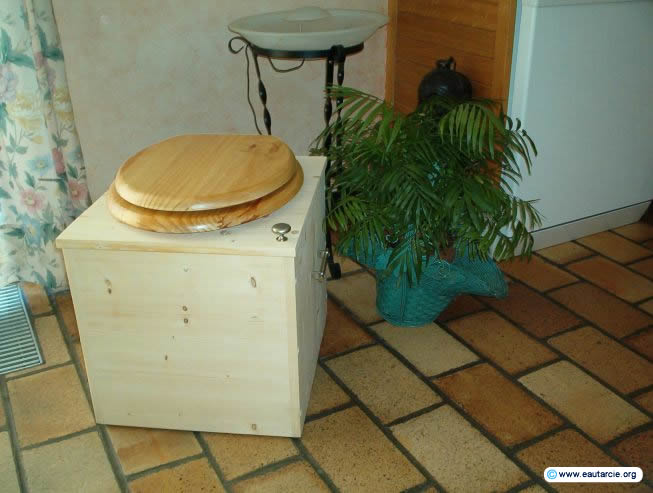 (BLT) are at the state-of-the-art in terms of global sustainability. Since present-day society refuses to even consider selective gathering and collective composting of human dejecta, it becomes the responsibility of individuals to take charge of the problem. Those who already compost kitchen or garden wastes will have less problem adapting. In most areas, composting dry toilet effluent adds little extra work in this regard. Others will have to learn composting basics, which, according to some, is almost an art form. We don't intend to contradict other excellent literature available on the subject. We simply purpose to provide more technical data on the specifics of composting human waste.
Elementary Rules of Good Composting
The purpose of composting is to restore animal- and plant-sourced biomass back into the process of humus formation, which is the « brown gold of the earth ». Without humus, we are quickly heading towards arable land loss and eventually desertification . This can only lead to additional climate changes and worsening water (and food) shortages. The converse is also fortunately true [2] restoring humus content to soil will regenerate land, modify (i.e. stabilize) climate, and re-establish soil's moisture regime. Water problems then resolve themselves without other intervention. Remember that humus can hold 50 times its weight in water. Humus restoration stabilizes sandy soils, protecting them against wind and water erosion. It makes compact clay soils friable and easier to till. [3].

...if this is corrected in time. When earth has been totally eroded, regenerating the soil becomes quite difficult.
History has shown that there is an intimate link between humanity and humus. When humus disappears from land, man must ultimately move on. Most human migrations and bloody wars are a result of soil degradation. A civilization's fate is ultimately dependent on farmland's capacity to feed its people, which is tied directly to the soil's humus content.
Humus is organic matter composed of large molecules (humic acid), the elements of which are present in plant and animal biomass [4]. Plant biomass provides the carbon « skeleton » whereas animal biomass provides the « flesh »: nitrogen- and phosphorus-containing protein. The whole is « seasoned » with mineral salts. The soil, with its clay, calcite and sand particles provides the support on which the synthesized humic acid particles fix themselves. This forms a clay-humus complex that is the ultimate phase of what is called stabilized humus. For further reading on this, go to the importance of humus.
The word « element » used herein does not refer to chemical elements shown on the Mendeleev periodic table, but to macro-molecular sequences having a relatively large carbon-based framework. Plant cellulose (that is found in litter) thus constitutes the structural support for synthesis of humic acids. Without this support, the large nitrogenous molecules contained in dejecta will decompose into carbon dioxide (mainly in an aerobic milieu), methane (in an anaerobic milieu), and water. Their nitrogen components will turn into ammonium ions, nitrites and nitrates. That is why there cannot be humus formation when sewage is discharged into water. On the contrary, nitrogen is mineralized and thus becomes a water pollutant. Wastewater purification, which is none other than the treatment of nitrogen-containing organic compounds seriously undermines the biosphere.
First Golden Rule – contact with the soil
Composting must be done in direct contact with the soil [5]. This follows from the above observations. As an extremely complex biological process, composting occurs thanks to the microscopic and macroscopic fauna that naturally thrive in the soil. These organisms' lifecycles include activity in the soil below, but also in the compost above. There is continual movement and exchange between the two zones. Composting on a concrete or wood pad or in a plastic container prevents these essential exchanges within the composting process [6].
Plus, compost must never be done in a hole in the ground, or covered with a plastic sheet. Such practices hinder the essential aerobic exchanges with soil organisms and insects. Organic matter placed in such conditions will rot and generate unpleasant odours, instead of being transformed into humus.
Second Golden Rule – the C/N ratio
You must find the right balance between plant- and animal-sourced components in the compost. From a scientific point of view, the carbon/nitrogen ratio must be between 40 and 60, at the start of composting. During composting, this ratio goes down and stabilizes at about 14. Most people are not equipped to measure this ratio, but that is not essential. When you have acquired the « art » of composting, you can « feel » what scientists can measure with their instruments.
When compost contains too little animal matter, the composting process is slow. Dead leaves can take up to two years to decompose without addition of dejecta. Plant stems and twigs remain relatively intact and the compost tends to dry out. On the other hand, when there is too much animal manure, the compost will smell bad. When you turn it over after a few months, the smell of ammonia will be omnipresent. The compost tends to be moist and compact. The process is no longer that of composting, but rather of rotting. This is what often happens when you try to compost kitchen wastes in plastic containers.
Third Golden Rule – the moisture content
You must find the right moisture balance. Good compost is not too moist, nor too dry. When building up the compost pile, it is relatively simple to check this. When removing your foot from the compost pile, if you boot makes a suction noise or the compost sticks to your sole, the pile is too moist. It will tend to settle and become compact. It will rot for sure. In contrast, if you detect the presence of too many sowbugs or pillbugs, the pile is too dry.
In too moist compost, you must add straw, plants with stems or even twigs. This will also bring better aeration to the pile. Let's not forget that composting is mainly an aerobic process.
In too dry compost, you must make sure that there is enough animal-sourced matter (usually very moist). Then again, an excess of twigs (from hedge or tree trimming) will make your compost too dry. Generally, the addition of BLT effluent quickly rectifies the situation. This same phenomenon happens when you put too much wood shavings as litter in your dry toilet. Therefore, when building up your compost pile, those few times that it may be too dry can be offset by watering the compost, without however flooding it.
Fourth Golden Rule – the time to cure
Composting needs time. The minimum time necessary for microorganisms and other soil organisms to do their work depends on local conditions, including the average ambient temperature. Composting and the use of compost must also be adapted to the seasons [7].
In temperate climates where the classic four seasons (spring, summer, autumn and winter) govern life, composting takes place within the annual cycles of gardening. The proper composting of a correct balance of plant- and animal-sourced biomass, containing dejecta, needs at least one year to cure before actually being ready for use. Considering that at the end of the first stage of composting (i.e. 12 months after having started up the compost bin), the compost will not have fully cured (because fresh matter is continuously added on throughout the year), composting must continue longer. For this reason, and as explained later (under « Preconceived notions »), we prefer a composting cycle of 2 years).
In those temperate areas where winters are harsher, composting is a slower process, requiring that it extend beyond 2 years. Thus, just like our recommendation for milder temperate climes, we prefer that composting extend an extra year where winters are harsher, i.e. a composting cycle of 3 years. For further reading on this, go to the paragraph on composting in winter.
On the other hand, in warmer tropical climates where life is mainly governed by two seasons (wet season and dry season), composting occurs more quickly. After 3 to 4 months, you can already empty your compost bin to start the second stage of composting: we deem that composting will have fully cured within the first year.
Of course, it is always possible to accelerate the process by using compost activators (or by composting within a greenhouse, for example). The desire to make compost with activators may constitute a lack of farsightedness. When correctly managing the composting system year after year, one will always have compost on hand to fertilize the garden. We should be wary not to precipitate natural processes, at the risk of provoking some unforeseen natural backlash. (The situation is altogether different when it comes to centralized collective composting, where the duration of the process determines the land area required to support it. In this case, the use of compost activators can be considered, and even glass-enclosed « greenhouse » composting.)
Preparing the Litter for the BLT System
One of the best litters available comes from one's backyard/garden: dead leaves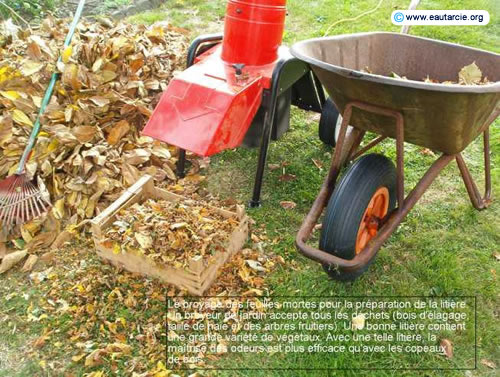 , dried grass clippings, hedge and tree trimmings, branches from pruning, culled weeds, etc. To make these more easily useable, it is better to use a leaf shredder
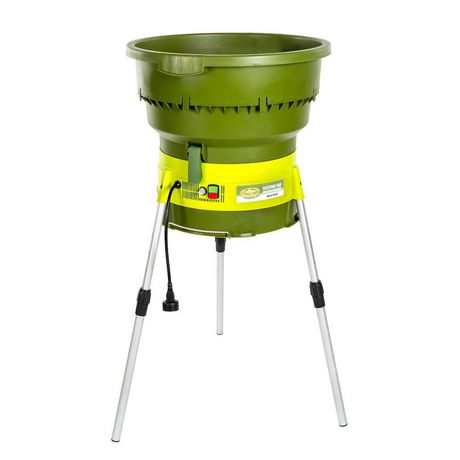 or a plant shredder
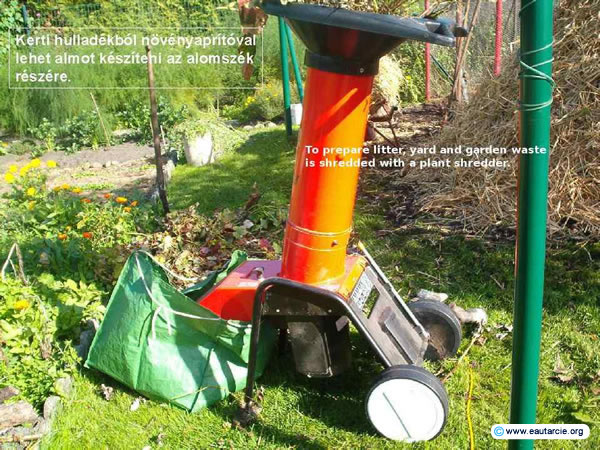 . About plant shredders
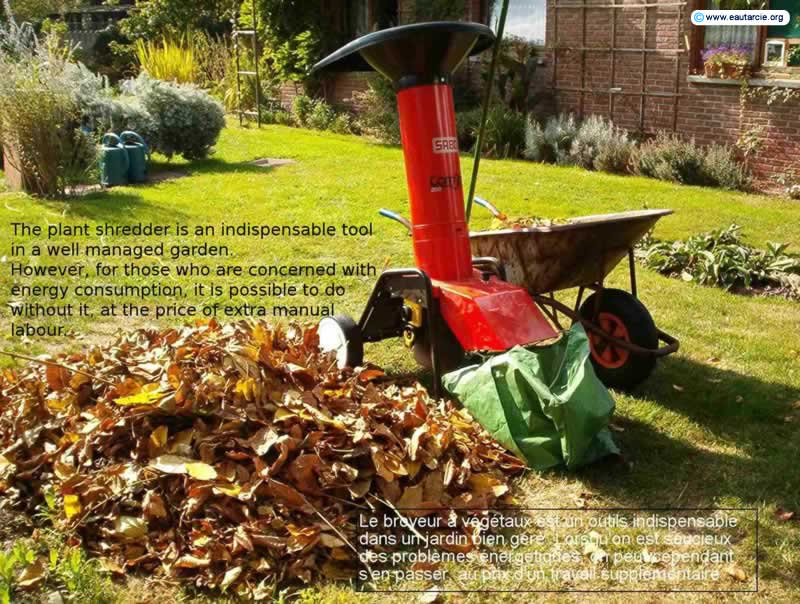 , you may want to choose a good quality shredder. Low-power shredders (less than 2200W) are slow and tend to jam frequently. One will waste more time unblocking the shredder than actually shredding plants. Also, without denying their usefulness, we feel somewhat uncomfortable about them because they consume expensive electric power or fuels. We have noticed that dead leaves
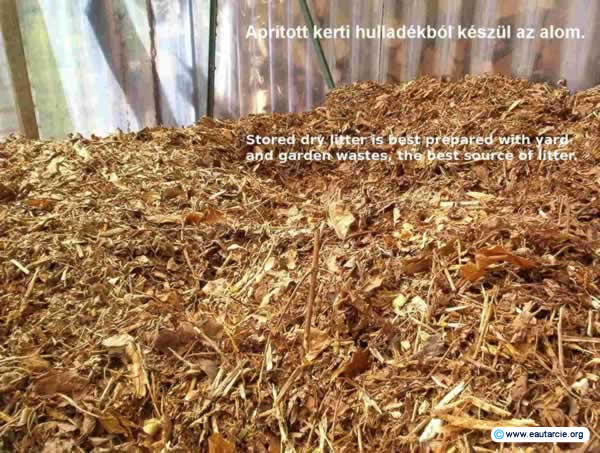 , culled plants or weeds easily break up into smaller pieces after having been left to dry for a few months (sheltered from rain). As such, they supply an excellent litter, without electricity (coal or nuclear produced) or fossil fuel consumption.
Many people use shredded paper as litter, processed with commercially-sold paper shredders. This makes an excellent litter material, although it could better be recycled into paper. Others use corrugated cardboard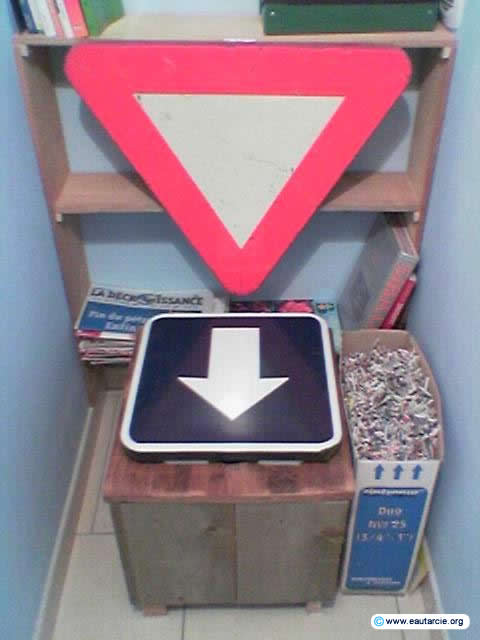 which, when moistened, easily shreds into small pieces. Despite the presence of printing inks, cardboard makes an excellent litter. The inks entirely decompose during composting, without leaving any toxic residue. However, you must first remove any plastic (stickers, wrapping) and metal (staples). Shredded paper towels of all sorts (soiled kitchen towels, napkins, facial tissues) also make good litter.
For those who don’t have time to make their own litter, you can also purchase your litter material at woodwork shops. Wood shavings and sawdust are sometimes given out, although an inconvenience with this litter is the dust generated (when used in the home for the BLT) due to the fact the wood has usually been kiln dried. To avoid dust, you can moisten the litter before use, or purchase sawdust or shavings from green wood (freshly sawed) that can be obtained at sawmills.
You can also purchase commercially sold animal litter (bedding) made up from plant based materials. You can even use compostable cat litter.
Finally, some people add odoriferous medicinal plants to their litter to provide a pleasant scent in the room.
Materials that are Inappropriate as Litter
Earth and mineral-based materials
Remember that the microorganisms that play an essential role in the composting process feed on organic matter, not on minerals. Earth does not contain, or contains too little organic matter to support composting. Too much earth will inhibit the microorganisms’ activity. This also applies to minerals in their pure state, like sand or, for example, clay- or silica-based mineral cat litters.
In addition, our dejecta's carbon/nitrogen ratio is too weak for humus formation. Thus, when mixed with earth, a good part of our dejecta's organic nitrogen is quickly lost by spontaneous mineralization (transformed into nitrates, nitrites and ammonium) in the absence of carbon.
Ashes or lime
Ashes and lime are also mineral-based materials upon which bacteria do not feed. Moreover, being highly alkaline, these materials also inhibit the bacterial activity that needs to take place to transform organic matter into humus. At best, you can add a bit of ash in the compost heap, but not in the BLT.
Old-timers say, « Lime makes the father rich, but makes the son poor ». Lime and potash (an ash component) accelerate the spontaneous decomposition of soil's humus, by quickly freeing organic nitrogen and phosphorus. As a result, agricultural yields will surge while the soil's humic reserves decline. The addition of lime to compost, as recommended by some agricultural specialists, interrupts the process of soil regeneration. Such compost acts just like a chemical fertilizer.
Peat moss
Even though the carbon/nitrogen ratio can easily be adjusted with peat, let's not forget that it is a non-renewable product. In addition, it has been observed that peat moss does not control odours very efficiently, likely due to its acidity [8].
Those who understand Rudolph Steiner's work (on biodynamics) will quickly understand the fundamental reasons peat is inadequate to adjust our dejecta's C/N ratio. Instead of rejecting his work outright, scientists would be surprised by the findings they would find there for further useful research.
Sawdust and wood shavings from tropical wood species
From our experience, sawdust and wood shavings from exotic wood species can generate bad odours and provoke allergies when used in the home as litter for the BLT. It can however be used for composting outside without problem.
Leaves and needles from coniferous trees
We have also observed that leaves and needles from coniferous trees are difficult to compost, when used alone as litter material. This is likely due to their acidity. It is best to mix them with other organic matter to provide a balanced litter. Needles are covered with a waxy outer shell that inhibits their absorptive capacity. It is therefore preferable to use them only for composting outside, as they will not adequately control odours in the BLT receptacle.
Classic Composting Method
Joseph Országh’s composting technique for human dejecta is a two-stage process.
Stage One – the compost bin
To start, set up a compost bin [9] in a corner of the yard not too far from the house, sized on the basis of about 1 m² per person in the household. The sides can be fenced in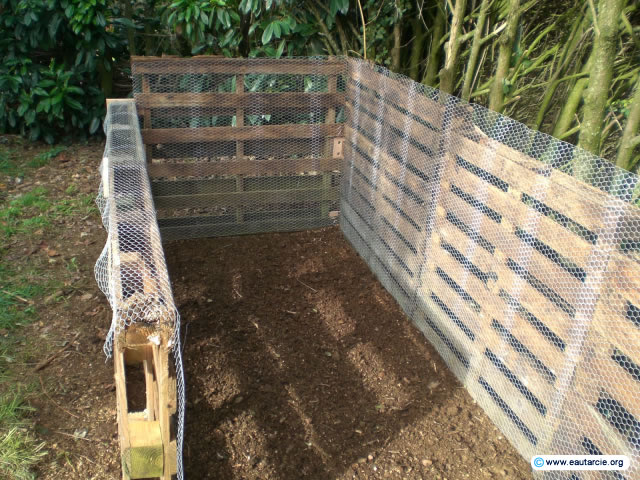 with a latticed frame and chicken wire or other wire mesh. Provide enough manoeuvring space
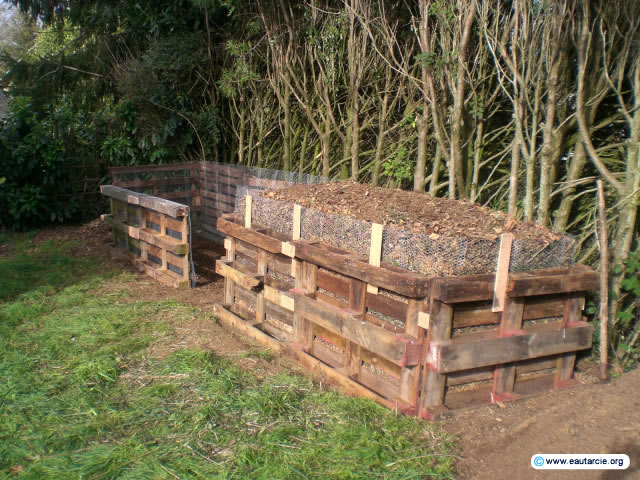 for wheelbarrow access. Before starting to fill your compost bin, make sure to first till and rake the soil. It is better that the compost be in a lightly shaded area, under small trees for example.
The term « bin » herein applies to those compost enclosures that are open to the ground. Worldwide, the term « composting bin » is a carryall term for all types of compost enclosures, including closed containers or floored enclosures that prevent direct contact of the compost with the soil. These are inadequate compost enclosures. Always choose those that are open to the ground.
In the compost bin, you put in everything that must be composted, doing this all year long. This will include garden and kitchen wastes, and dry toilet effluent. If you expect to start off your compost with more BLT effluent than plant waste, place a 20 to 30 cm layer of straw bedding at the bottom of the compost bin.
Every time you empty the BLT bucket content into the bin, make sure to cover the effluent with additional litter, e.g. straw, grass clippings, culled weeds, dead leaves [10], etc. (During the cold season, put a thicker layer of litter to help conserve heat within the compost.) Then, immediately rinse the bucket and put it back in service, in the BLT.
At home, Joseph Országh prepares his litter with dead leaves and trimmings from hedges and fruit trees, having first shred them with a plant shredder. After grinding or shredding, the plant waste must be left to dry (especially if it was green initially). This recipe better controls odours than do wood shavings for example. The litter can be stored in a greenhouse, a barn or a garden shed.
After one year, the compost bin should be full. Thereafter, preferably in autumn or at the start of winter, it is time to start up your compost heap, which is a second compost set-up, nearby but separate from the primary compost bin.
Stage Two – the compost heap
You now empty the compost bin to build up a compost heap. After having tilled and raked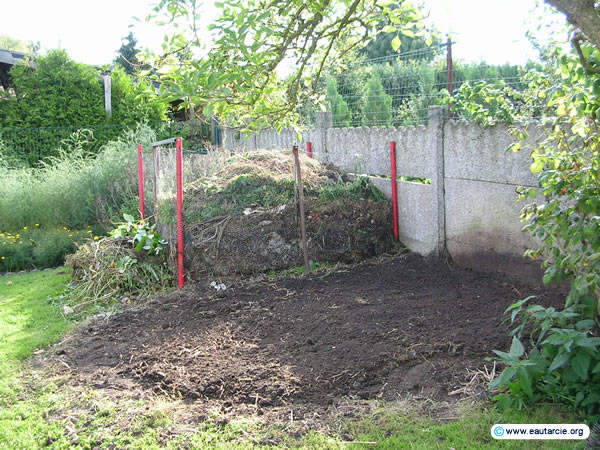 the area you wish to use for your compost heap, you transfer the entire compost bin contents to the intended heap, stacking it layer by layer to create a pile with a sloped roof configuration. The pile will measure about 1.3 m wide at its base, and 1 to 1.2 m high. Its length will be determined by the quantity of matter that needs further composting. You can also build up the heap within a wire-screened enclosure.
The base of the heap should start with a bedding of twigs or straw. This will promote better aeration. Than, continue by putting fresher (less decomposed) compost matter at the bottom. Fill in progressively with the older more compact matter. As an option, you can spread some basalt mineral fines (also known as basalt dust) and calcareous algae meal (such as lithothamnion, a kind of marine algae used for soil improvement in Europe), between each layer. You can also put in some wood ash (not too much), but no lime. If the compost is used for asparagus crops, a bit of powdered premixed plaster can also be added.
Finally, cover the heap with a 20cm thickness of straw. Then, lay a few branches on the straw to prevent its dispersal by birds, as it will not take long for these to seek out the exposed worms. (In the mean time, the emptied compost bin is again tilled and raked at its bottom, and a new composting cycle begins.)
The compost heap is then left to itself for one year
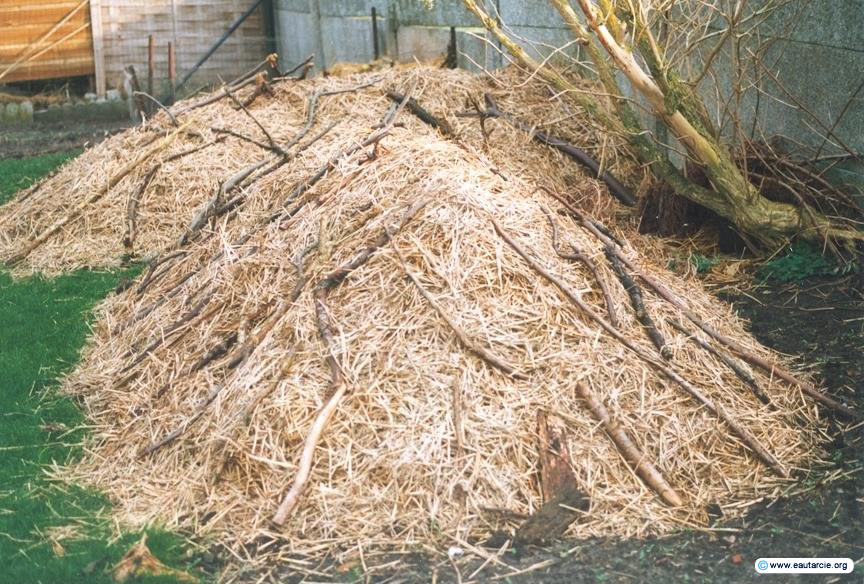 . Its volume will shrink by more than 50% and its straw topping will have been partly absorbed. Before again emptying the compost bin, the compost within the heap will be transferred near the vegetable garden. Ripe compost
 is friable, brown, and has the sweet smell of earth. It is then ready for use in the garden, flowerbeds, etc. It is best to use it before winter. Part of the remaining stored compost should be covered with straw for the winter, to be used for interior seed start-up and spring planting.
Single-stage composting techniques
Although composting is not yet fully adopted worldwide as a gardening technique, most who practice composting usually limit its application to garden and kitchen wastes: no animal or human manure is added. For this reason, composting is usually performed as a one-stage process.
The two-stage method described above is the technique that has been adopted by Joseph Országh for many years with great success, for composting human dejecta. The experience of other master-composters will be different, as practice makes the master. What is more, local temperature and rainfall conditions will influence the experience and method of each master-composter. One must compost with a sense of observation while at the same time complying with the four golden rules defined at the start of this chapter.
The American Joseph Jenkins has adopted a one-stage method, whereby the compost bin is left to itself for the whole 2-year process. Many others have adopted a method using two or three separate compost bins that are used in rotation, one after the other, from one year to the next, sometimes in a one-stage process (no transfill activity, like Jenkins), sometimes in a two-stage process (transfering the contents from a first bin to a second bin after a period of time). See images of installations of these kinds on the Humanure Headquarters website.
Ground Surface Composting Method
Older persons often find it difficult to empty the compost bin to build a separate heap. Handling a pitchfork is not to everyone's liking either.
In such cases, one option is to reserve a few square meters of your garden (or « backyard » in North America) for spreading of BLT effluent directly on top of the soil, to a thickness of 15 to 20 cm. To prevent exhibiting toilet paper and the like, you cover the toilet effluent with some plant matter: dead leaves, grass clippings, culled weeds or straw. Some people use wet cardboard packaging, which is efficient, but not very sightly. Yet, this is the most ecological way of eliminating this type of man-made waste. While the soil is « digesting » the matter, printing inks are fully eradicated in a matter of months. It is however wise to initially remove packaging staples (metal) and tape (plastic).
The effluent that has been spread in this way is a remarkable stimulant for the soil's wildlife. Countless earthworms appear and transform our dejecta into precious humus. This can indeed be the simplest and most efficient way of remediating polluted industrial brownlands, and regenerating degraded and sterile soils (artificial embankments for example). After a few years of such a treatment, a sterile sandy soil becomes a light and humus-rich soil that holds together. A compact clay soil becomes crumbly and fertile. A rocky or gravelly soil is transformed into fertile land.
Thus, thanks to the BioLitter toilet, anyone can create a flourishing garden anywhere, without classic composting.
Ground surface composting is well adapted to activities such as Boy Scout summer camps or jamborees, for example. Toilet effluent would be spread in a distant corner of the woods or field, and covered with plant matter such as fallen leaves. Obviously, measures would need to be taken to prevent people from accidentally walking on or passing through the designated patch of land.
Preconceived Notions on Agricultural Reuse of Human Dejecta
In Joseph Országh’s contacts with the public, the subject of health risks on using composted human dejecta in the vegetable garden periodically crops up.
Remember that stable manure (sheep, cow, etc.) is commonly used in our gardens and fields, yet it contains the same pathogenic bacteria as human excreta. Remember also that sewage sludge and septic tank sludge are also used in agriculture. The larger public often ignores, or does not realize that vegetables we buy on the market can come from farmland that has been fertilized with septic tank sludge, and even sewage sludge. This sludge contains much more reputed pathogenic bacteria than composted dejecta. In addition, sludge contains intestinal parasite eggs not found in compost [12]. Yet, spreading septic tank sludge on land is accepted in most countries and even encouraged by legislation in some of these, without this fact apparently disturbing people concerned about sanitation. Farmers are often registered as septic tank sewage collectors.
After 18 months of aerobic composting, the eggs of intestinal parasites disappear. This is far from true in sanitation plants where black water is only held a few hours. The parasites and their eggs are then discharged back in nature as treated water (eventually getting to bathing sites such as sea-side beaches) or as treated sludge spread on farmland. Bathing on the seacoast is a greater risk (if risk there is) than taking a bath in filtered rainwater. Pre-set notions and preconceived ideas about bacterial contamination are pertinacious!
When composting is inadequately done, concerns about health risks are partly justified [13]. Composting time is of the essence: that is why classic composting must be extended to 2 years (in temperate climates). During compost's 2nd stage of curing, intestinal parasite eggs altogether disappear. During this stage, compost becomes reticulated by a mycelium network. These microscopic fungi represent a genuine antibiotic that eliminates pathogenic bacteria, but they only show up near the end of the second year.
Intestinal parasites represent a greater danger when sewage sludge is spread on agricultural land. For the same reasons, water discharged from treatment plants is a permanent threat to bathing areas, including beaches on the seaside, near river outlets or near water treatment plant outlets.
Let us also speak of the Chinese Emperor Syndrome. It is said that Chinese emperors, unlike their subjects, did not consume food harvested from fields that had been fertilized with night soil (human manure). It is also said that grazing animals do not eat grass that grows on their own dejecta. Yet, we mustn't lose sight of the fact that:
- The Chinese did not compost their excreta, but used them directly on the soil;
- Prairie grass fertilized with composted manure is well accepted by animals.
There is no doubt that non-composted dejecta introduce many pathogenic germs in our food production milieu. (This includes liquid pig manure, septic tank sludge and sewage sludge that are commonly spread on farmland). In contrast, the use of composted dry toilet effluent does not present this inconvenience. Its pathogenic bacterial content is much weaker than that of septic tank sludge or industrial pig manure. (People's fear of manipulating human manure lacks objective reasoning; denial and refusal will always find some sort of justification. Ultimately, reluctance to use human manure is profoundly psychological and cultural in nature, as is fear of bacterial contamination.)
Composted human manure increases land's water holding capacity, and in so doing, reduces irrigation needs. Each kilogram of compost that is substituted for chemical fertilizers reduces agricultural pollution, AND it also reduces pesticide needs.
Let us insist on the fact that the composting process starts in the BLT receptacle. Therefore, what we put in the BLT is of great importance.
Medicine in Composted Dejecta
What happens to compost's quality when we ingest medicine, particularly antibiotics? Concerns are primarily expressed about potential medicinal residues in vegetables fertilized with such composted manure. There are also concerns about antibiotics' effects on beneficial bacteria during composting. (Remember: antibiotic = antibacterial).
First, it is rare that all members of a family take antibiotics all year round. Antibiotic absorption can only be temporary. Let's not forget that compost is also composed of kitchen and garden wastes. Therefore, an antibiotic's concentration will be quite weak in the overall compost.
In 1998, we proceeded to an interesting composting experiment at one of Belgium's experimental farms (Ferme Modèle de l'Institut Agricole de Ath (CARAH)). Liquid pig manure from a local pig farm that made use of great quantities of antibiotics was used to saturate a pile of shredded wood waste reclaimed from a nearby housing demolition. After a few days of saturation, a compost pile was built up. Start-up samples were analyzed by gas-phase chromatography. The analyses highlighted great quantities of organic pollutants: antibiotics, colourings and paint residues, wood preservatives and fungicides, etc.
Contrary to predictions, the antibiotics did not kill any composting bacteria: after a few days, the temperature at the centre of the pile was greater than 60°C. After 3 months of composting, new analyses were performed on the compost. Organic pollutants had almost altogether disappeared: the chromatogram showed only « background noise ». The concentrations of the various pollutants were practically undetectable by this method (which is sensitive enough). Albeit, we noticed that heavy metals that were present at the start of composting remained in the compost.
Our project – the financing of which was refused by the state, but also by the European Community – intended to develop a composting technique that would make heavy metals biologically unavailable, therefore, non-absorbable by plants. This was of particularly interest for brownfield (contaminated industrial land) soil reclamation and dredging of gravely polluted river/canal sludge. It was intended as an elegant approach to cleaning these sites, relatively easy to implement and not too expensive. As they considered composting to be insufficiently innovative, the regional and European decision-makers preferred financing other projects, such as removal of polluted soil, its trucked transport to a centre for lixiviation with concentrated sulphuric acid, neutralization of the acid, washing the lixiviated earth and putting it back in place, all this at an extremely high cost. As to what they intended to do with the pollutant-containing sulphuric acid, we were answered that « some other company would take charge of it » (i.e. to dump it in a controlled toxic substances landfill site)!
To conclude, the two-year period prescribed above for composting of dejecta is quite sufficient to eliminate antibiotics and any other medicinal residues from compost before its use in the vegetable garden.
Composting in Winter
According to Canadian sources, the composting process continues into early winter, but slows down and even stops once extreme cold has settled in, especially in smaller-sized domestic composting bins (measuring less than 1 m³). Bacterial activity in the compost diminishes substantially as outside temperatures drop below –10°C, especially when the bin is exposed to the winter cold on all sides. Based on André Leguerrier’s experience in Montreal (Canada), considering that winters there last close to 5 months (and where the ground freezes to close to 1.5 meters (5 feet) deep), single-stage composting of dejecta in a fully exposed compost bin requires a curing time of over 2 years, even up to a full 3 years. Yet when applying Joseph Országh’s two-stage technique by which the compost is transferred into a sloped heap and covered with a heavy insulating layer of straw, compost is ripe at the end of the second year. Incidentally, André Leguerrier’s experiments have shown that dejecta that is spread directly on the ground (see paragraph on ground surface composting) and covered with straw are fully absorbed by the soil after one full year, notwithstanding Montreal winters.
In the northern USA where winters are generally milder than in Canada, a composting cycle of 2 years is satisfactory, based on Joseph Jenkins’ experience (in Pennsylvania). Jenkins keeps adding his kitchen waste and toilet effluent to the compost bin throughout winter (as does André Leguerrier in Canada), taking care to add litter on top of the heap, frozen or not, in expectancy of the spring thaw. Jenkins has observed that the core of his composting bin frequently does not freeze at all during the winter. Nevertheless, the composting process is more active between spring thaw and winter freeze-up.
Winters in continental Europe, like in Hungary, can also be pretty harsh. Experiences in Hungary have shown that when the compost heap's volume exceeds 2 m³, the core of the heap does not freeze, even when outside temperatures hit -20°C for weeks on end. Moreover, compost heaps in large-scale or industrial set-ups maintain a constant temperature due to their large size, whatever the outside temperatures.
Generally speaking, for small-sized composting bins, winter is mainly a season for holding organic matter than for actual composting. In spring, compost that has frozen will begin composting with renewed vigour upon thawing. Winter composting activities involve additional tasks inherent to snowy regions, such as snow removal to maintain access to the compost bin, and snow removal from the bin itself. Since the compost bin must be covered up with litter after each use (for example with hay or straw), the litter should be stored in a shelter close by to keep it dry and manageable.
To conclude, where winters are harsh, the duration of the composting cycle depends on the composting method used. For single-stage composting (no transfer of compost from the bin to a straw-covered heap), and where winters are extremely cold, the composting cycle will likely need to extend beyond 2 years before the compost is fully matured. However, ground surface composting does not seem to be affected by winter.
To continue reading, go to BLT's on the market