


















 Homepage

 EAUTARCIE homesTestimonial from AndalusiaContact
The houses shown on this page are older projects derived from our work at the University of Mons. Funding for this work (by the Walloon Region) was subject to a prior condition: purify domestic wastewater as much as possible. Since the date of Joseph Országh’s retirement from the university in 2002, the EAUTARCIE concept has become free from academic constraints. The ideas that had already been conceived in 1992, although partly developed, were now able to mature, free from mental barriers imposed by the academic world. Overall, a change of paradigm imposed itself: by considering that wastewater is a fully recoverable resource, not waste, the idea of wastewater purification has been abandoned. The technical aspects of EAUTARCIE have themselves been « purified », thanks to the help of friends and correspondents. Given this, the greywater purification system we named TRAISELECT is no longer relevant, since wastewater treatment is the worst thing one can do with wastewater. Our techniques are now simpler, cheaper and more efficient. These techniques are what we offer to the public on this website. Nevertheless, they are still evolving.
It is interesting to read a testimonial from Andalusia (Spain) on EAUTARCIE’s benefits in dry regions.
The EAUTARCIE website has been adapted and translated from the French version by André Leguerrier architect, Montreal, Canada.
The text within this page was first published in French on www.eautarcie.com: in 2003
The original text has since been adapted and first published in English on this page at www.eautarcie.org: 2010-06-24
Last update: 2017-02-06



EAUTARCIE Homes

Autonomous Home in Malonne (Belgium)
Home not connected to centralized sewerage or water supply networks. Before recent ownership change, besides the original three family members, the house also accommodated a small centre for the practice of yoga. One of the two BioLitter Toilets was made available to the centre’s clients and accepted without problem.
Technical data:
- Whole-house rainwater harvesting;
- Roof area (measured horizontally): 120 m2;
- Four prefabricated concrete cisterns having a capacity of 5.000 litres each (total 20.000 litres = 20 m3);
- Drinking water produced from rainwater using the AQUASAIN filtering system (Société Dellan & Co);
- Two BioLitter Toilets (BLTs);
- Selective greywater treatment using the TRAISELECT System;
- Greywater batch reactor having a capacity of 5 m³, coupled with an uptake filtration tank (water drawn upward) laden with sand and plants. During construction in 1996, the planted trench filter was not used. Therefore, the owners installed a circulation pump with a 25-micron filter in the finishing treatment pond to ensure the water’s clarity.
Images
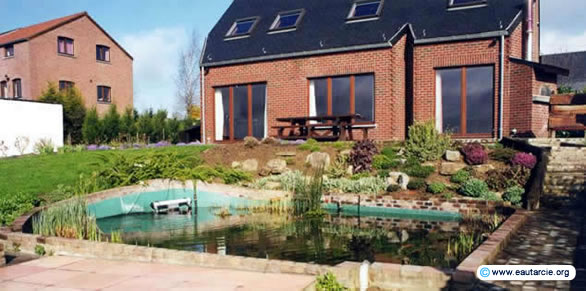
View of the home’s garden, with the greywater treatment system’s wetland finishing treatment pond
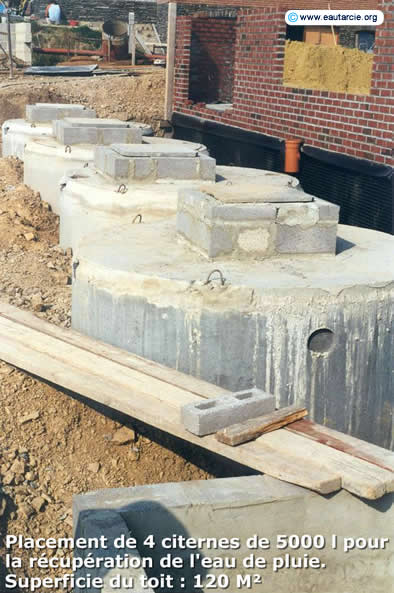
The four cisterns during construction
Another Home in Malonne (Belgium)
Home fully equipped with the EAUTARCIE system.
Because the house is situated in an area serviced by centralized sewerage, communal authorities ordered that the TRAISELECT system be put out of service, and the house connected to the sewers. Said sewer – in the absence of a sanitation system – discharged its effluent into the river, without any treatment. After a lot of bureaucratic red tape, the TRAISELECT treatment system was unofficially tolerated, tentatively. One problem with the set-up: the difficulty to infiltrate the effluent into the soil due to the water table’s very close proximity to the ground (the house was built in a flood plain).
Technical data:
- Whole-house rainwater harvesting using the PLUVALOR System;
- Roof area (horizontally-measured): 110 m²;
- 15.000-litre cistern (15 m³);
- Two BioLitter toilets;
- Selective greywater treatment using the TRAISELECT System;
- Greywater batch reactor (for 3 people): 2 m³.
- Planted soilbox filter: 2,5 m².
- Finishing treatment pond: 8 m² (too large, prone to low water level problems from excessive evaporation during hot summer spells).
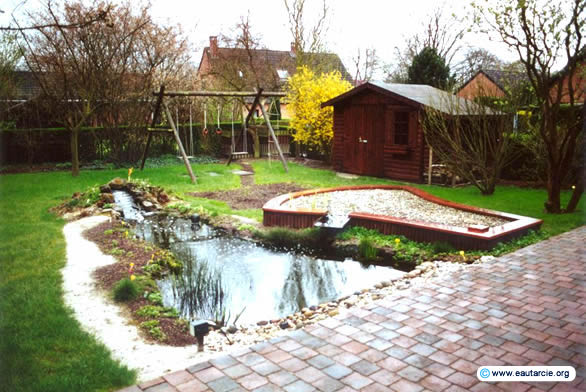
The planted soilbox filter can be seen next to the wetland's finishing treatment pond, after completion
City Home in Mons (Belgium)
Home not connected to centralized sewerage or water supply networks.
Technical data:
- Whole-house rainwater harvesting using the PLUVALOR System;
- Roof area (horizontally-measured): 100 m²;
- Rainwater cisterns (masonry-built) with a total capacity of 15.300 litres (15,3 m³);
- Drinking water produced from rainwater using the AQUASAIN filtering system;
- Two BioLitter Toilets (BLTs), the effluent of which is composted in the garden;
- The compost obtained is used to fertilize the vegetable garden and the orchard that cover up to 740 m².
- Selective greywater treatment using the TRAISELECT System;
- Greywater batch reactor: 2.000 litres (2 m³);
- Aeration tank: 300 litres;
- Planted trench filter: 2 m²;
- Finishing treatment pond: 6 m² (too large considering the quantity of greywater produced by the household).
Images
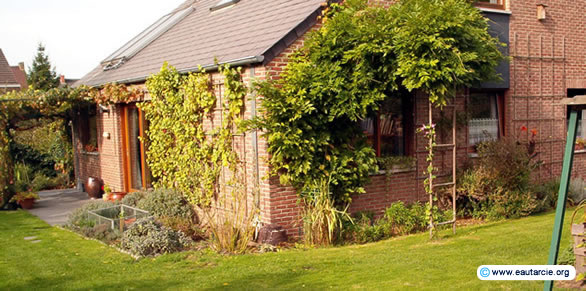
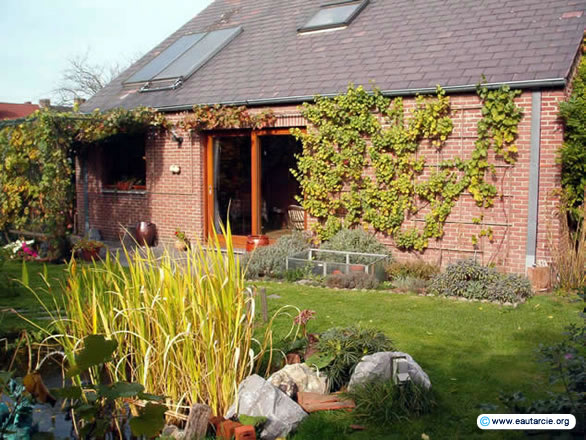
The home’s garden (or « backyard »)
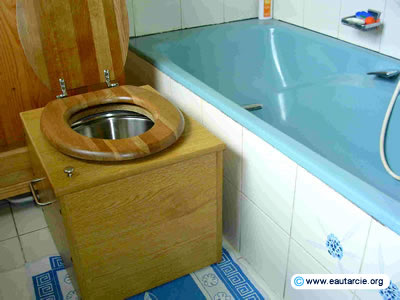
The BioLitter Toilet (BLT)
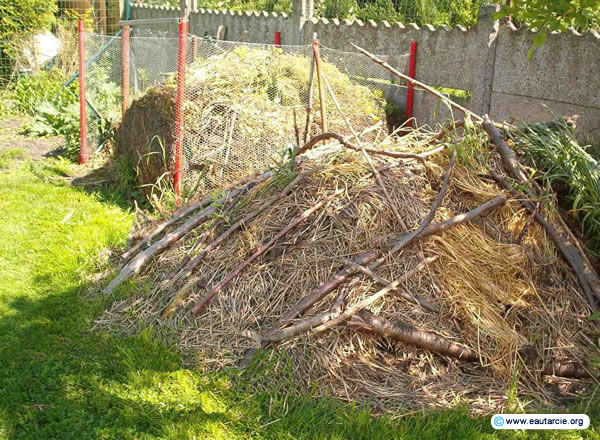
The compost area, including the compost bin during the initial stage, and the compost heap during the curing stage
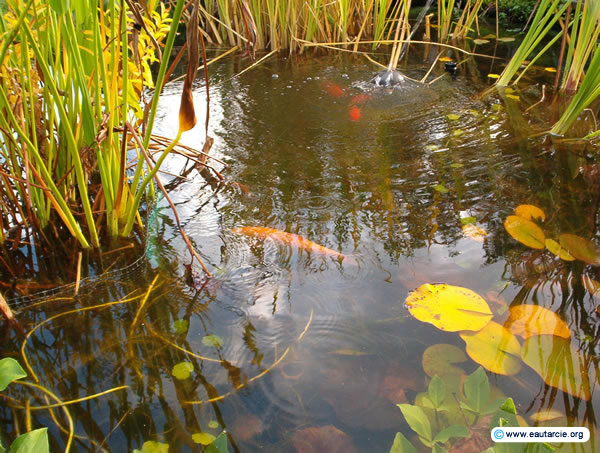
The wetland pond harbouring fish. The water quality at the overflow of this pond complies with European standards as water suitable for making drinking water
A Sculptor’s Home in Achenne (Belgium)
Home equipped with the TRAISELECT system.
Once the greywater treatment system was installed, the flush toilets were replaced by BLTs. After a few years of successful operation, the communal authorities decided to implement a sewer in the street. At that point, the owner was invited to disconnect his treatment system and connect his home to the sewer. After a lot of bureaucratic red tape, the treatment system was finally authorized in light of the fact it had been set up before the sewer.
Before final authorization, experts examined the system. In their report, they stated that « the water discharged at the system’s outlet does not comply with discharge standards ». Upon examination of the report, it turned out that the experts had monitored the water quality at the greywater reactor’s outlet, and not the water issuing from the wetland pond. Since both the trench filter and the wetland are watertight with respect to the soil, the ultimate outlet of the system is located at the pond's overflow, and not at the reactor’s overflow. The water quality issuing from the pond's overflow was close to potable water standards.
The planted trench filter was intentionally set up as a small decorative rivulet crossing the garden, draining to the 20-m² artificial wetland pond that is set at the property’s lowest point. The pond’s overflow discharges into an intermittent naturally occurring rivulet.
One incident: a light bacterial film appeared on the pond’s surface, the origin of which has never been ascertained. After a few months, the film disappeared.
Images
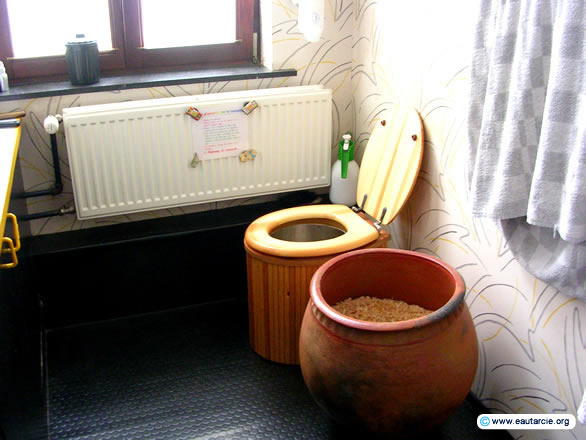
BLTs were installed after flush toilets were removed
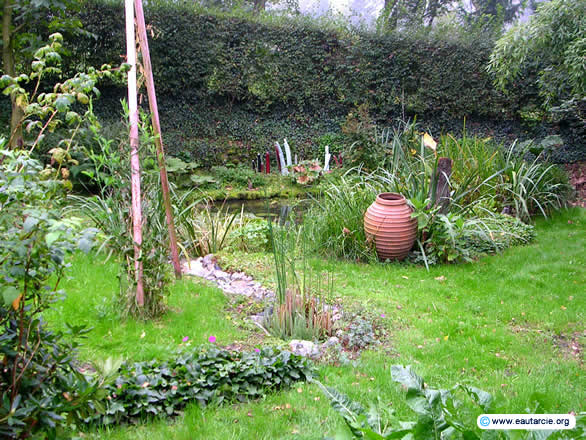
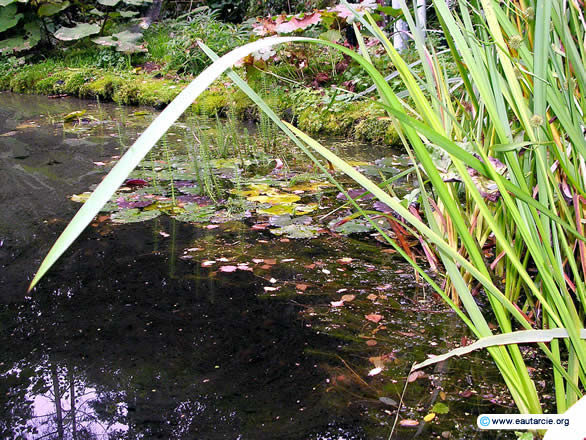
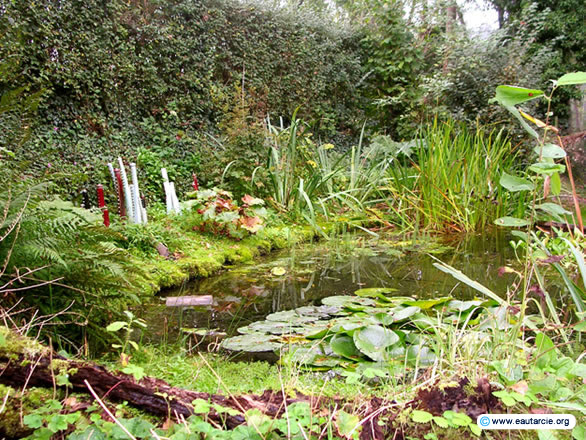
You can see the planted trench filter (1st photo) swerving towards the wetland finishing treatment pond (2nd and 3rd photos)
Camping de la Sablière Near the City of Binche (Belgium)
Camping ground with wood cottages or caravans (also called « trailers » or « RVs=recreational vehicles »).
In the campsite’s main hall (used for meetings, parties, conferences, etc.), a faucet delivers microfiltered rainwater.
The toilet and washroom facilities include many BioLitter toilets. An experiment that aimed to automate the proper dose of litter to be used ultimately failed. However, all conventional BLTs have provided satisfactory results with the public that uses them. Litter urinals can be found in many places throughout the premises. In order to limit the use of chemical toilets by the public, the administration has clients pay for the cost of emptying such toilets. On the other hand, BLT users receive litter free of charge, and they can empty their toilet effluent on a compost heap that is easily accessible. Yet in spite of this promotion, few campers have adopted these dry toilets.
The little greywater produced by the cottages is discharged into a planted trench filter, without an impervious bottom. Thus, the wastewater that is filtered by plants is infiltrated directly into the soil. On the other hand, greywater issuing from lavatories and communal showers is treated using the TRAISELECT System: batch reactor, planted trench filter and finishing treatment pond. The pond is a highly visible decorative element at the campsite’s entrance.
Images
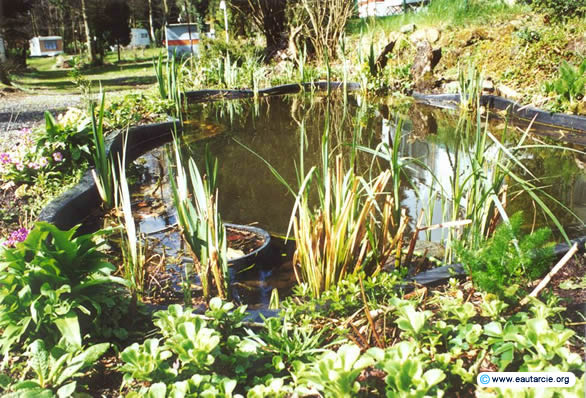
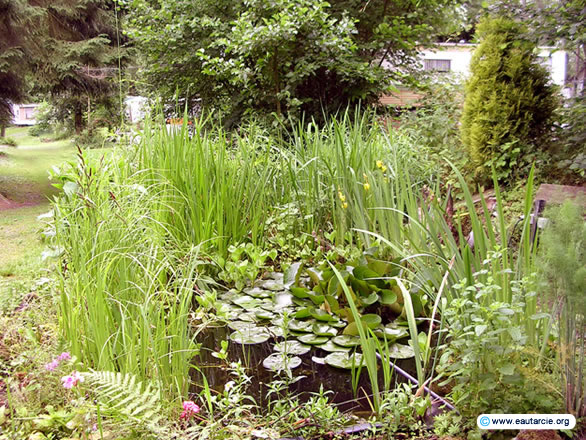
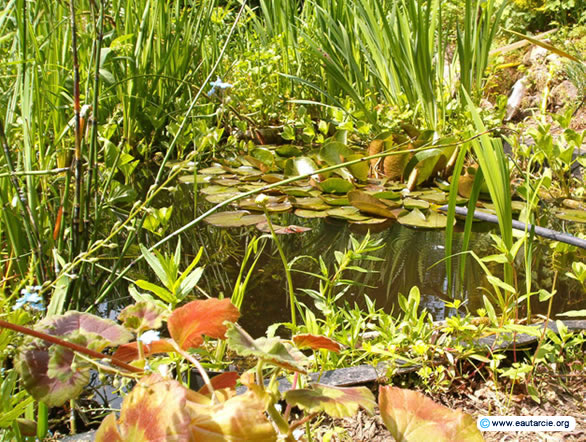
The constructed wetland pond for selective greywater treatment: as seen in April 2001 (1st photo) and in 2004 (2nd and 3rd photos)
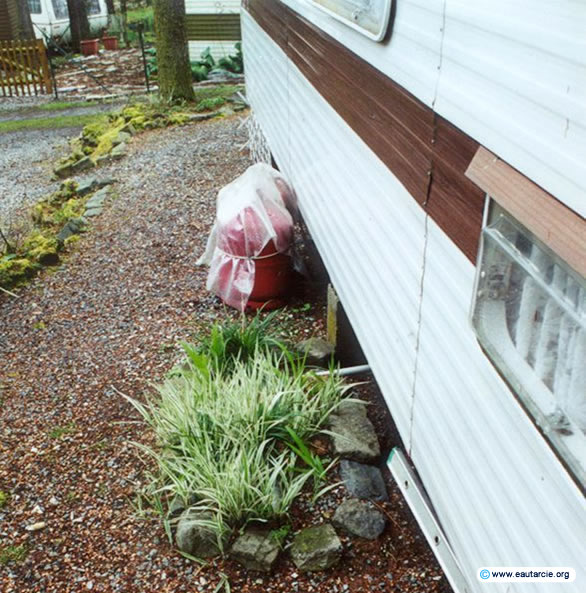
Greywater infiltration in the ground near each cottage or caravan